
Adaptive Edge Computing for Aerospace and Defense
Building systems for the tactical edge involves a well-known challenge: platforms must remain operational for decades, while missions, threats, and underlying technology evolve rapidly. This mismatch has historically forced integrators to choose between freezing designs and risking early obsolescence, or adopting custom architectures that sacrifice interoperability and scalability.
This trade-off is now being resolved. By combining AMD adaptive computing with the VITA 90 (VNX+) and VITA 93 (QMC) standards, it is possible to build truly modular, MOSA-aligned systems that adapt to evolving mission needs, even in the most size-, weight-, and power-constrained environments. At TEWS Technologies, we call this adaptive edge computing, which expands the capabilities of small-form-factor platforms.
Two layers of modularity, one design philosophy
VNX+ and QMC complement each other by addressing distinct challenges. VNX+ (VITA 90) serves as a rugged, compact system backbone, succeeding VITA 74 (VNX) while maintaining the familiar “deck of cards” footprint. It delivers high-speed fabrics required by modern payloads, supporting per-lane data rates above 25 Gbps, PCIe Gen 4/5, and 100 Gigabit Ethernet. Designed to align with SOSA, VNX+ enables small-form-factor systems to meet the interoperability and bandwidth standards of full 3U and 6U OpenVPX platforms.
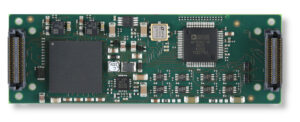
QMC (VITA 93) extends modularity to the functional layer. A single-width QMC card measures 26 mm × 78.25 mm and scales from single- to quad-width, supporting PCIe x4 with 40 I/O up to PCIe x16 with 160 I/O, and is compatible with PCIe Gen 6. The 40 I/Os per card are organized into five IOPIPEs, each providing eight single-ended or four differential lines with independent grounds, simplifying the implementation of isolated interfaces. The same card design supports both air- and conduction-cooled applications, and any compliant QMC can be used with any compliant carrier, eliminating the need to match specific mezzanines to carriers.
Combining both standards delivers what long-term programs require: a stable platform layer and an independently upgradeable innovation layer. The VNX+ backbone remains unchanged while QMC modules can be swapped or upgraded as missions evolve, eliminating the need for platform redesign or full system requalification.
Why adaptive computing is the natural payload
Modular hardware is most effective when the computing resources are equally adaptable. AMD adaptive computing integrates seamlessly with this architecture. Signal processing chains, sensor and waveform interfaces, and electronic-warfare responses frequently change throughout a program’s lifecycle, and these are precisely the functions that FPGAs or adaptive SoCs can re-target in the field without hardware modifications.
Applying this to the standards, VNX+ maintains a stable platform layer, while reconfigurable AMD silicon on a QMC module serves as the innovation layer that can be updated as threats and algorithms evolve. For example, a UAV payload can support multiple mission profiles on a single hardware baseline, an EW system can be adapted to new threat environments without redesign, and a dismounted C5ISR node can add new sensors or crypto interfaces through module changes rather than program changes. The modularity of QMC and the reconfigurability of the FPGA work together to maximize flexibility.
TEWS: the reference for QMC
TEWS Technologies has been an active member of the VITA Standards Organization for over 30 years and has played a key role in developing both VNX+ and QMC. We now offer the industry’s most comprehensive portfolio of QMC modules and carriers, including the TVNX210, the first dual-QMC carrier for VNX+ systems. Supported by five decades of embedded design experience, broad device-driver support, a five-year warranty, and full lifecycle and obsolescence management, our portfolio enables integrators to build with proven components rather than starting from scratch.
A partnership built for the edge
Adaptive edge computing requires seamless integration of standards and silicon, which is where our partnership with AMD is critical. TEWS is a Platinum-tier member of the AMD Embedded Partner Network and is recognized as an official AMD Aerospace and Defense Ecosystem Partner. This collaboration ensures our QMC designs are optimized for AMD’s adaptive platforms from the outset, providing co-engineering, early access, and long-term support for defense programs.
We have introduced two user-reconfigurable FPGA modules in the QMC form factor: the TQMC600 (Reconfigurable FPGA with Digital I/O) and TQMC700 (Reconfigurable FPGA with AD/DA & Digital I/O), both based on AMD’s Artix™ 7. These modules provide integrators with a standards-based, COTS solution for adaptive computing at the edge, along with the mechanical and thermal advantages of QMC.
This is only the beginning, and we are actively expanding the QMC portfolio to include additional AMD devices as customer demand increases.
What it means for your program
For design engineers and integrators, the benefits are tangible. You can standardize on a single architecture across platforms of all sizes, integrate new technology at the module level rather than the platform level, and reduce development risk and cost by using qualified building blocks. Multi-vendor sourcing within the QMC ecosystem enhances supply-chain resilience, while separating innovation from the platform directly addresses obsolescence and requalification costs that often impact a program’s later stages.
This is the true promise of adaptive edge computing: systems that are open and modular by design, inherently adaptive, and prepared to evolve as mission requirements change. With VNX+ and QMC providing the framework, AMD adaptive computing as the engine, and TEWS as your partner, next-generation aerospace and defense programs can accelerate innovation without sacrificing longevity.